
I have been actively involved in the field of environmental toxicology for over 35 years conducting research primarily on the effects of metals on aquatic organisms. I continue to be very interested in this field, particularly in improving our understanding of the physiological mechanisms of metal toxicity and using this information to develop tools for regulating metals in the environment. Translating our physiological understanding of how toxicants affect different levels of biological organization into practical tools that can be used by environmental managers and regulators is an ongoing challenge. Below are a few examples of the types of projects I work on.
Development of Multiple Linear Regression (MLR) Models for Deriving Water Quality Criteria for Metals
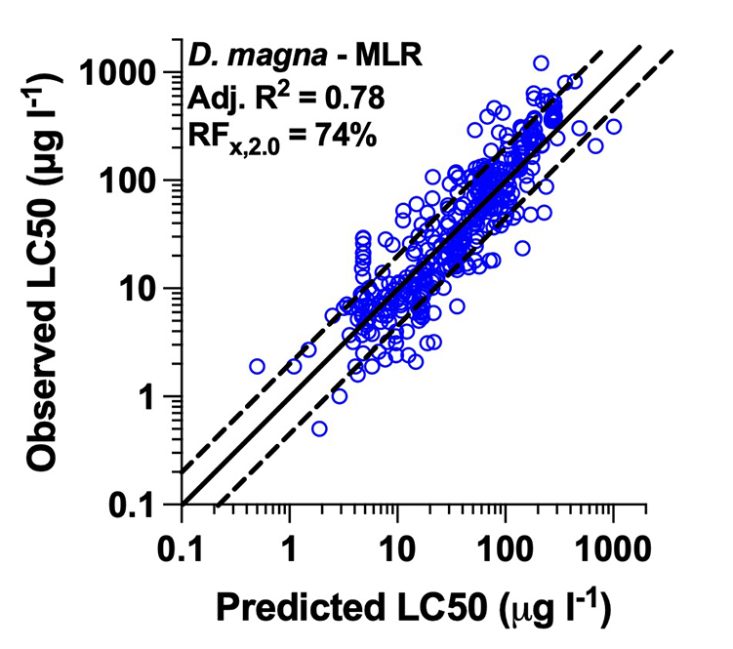
Accounting for the effects of toxicity modifying factors (TMFs) such as hardness, pH, and DOC is critical in assessing risks of metals to aquatic organisms and in setting appropriate water quality criteria (WQC) for metals. There has been considerable effort to develop quasi-mechanistic models such as the biotic ligand model (BLM) for this purpose, but in some regulatory settings they have been viewed as too complicated and requiring to much data to routinely implement. In collaboration with David DeForest, Lucinda Tear, and Bill Adams, I’ve been developing an alternative approach using multiple linear regression (MLR) models that are analogous to the widely accepted hardness-dependent models that have been historically used to set WQC for many metals. Our efforts have led to development of MLR models for aluminum, copper, iron, lead, nickel, and zinc. USEPA has adopted our aluminum MLR model for setting WQC in the United States (USEPA 2018) and has indicated future WQC for metals will use MLR models (USEPA 2022). The state of Washington has now adopted both our Al and Cu MLR models for setting water quality standards (WDOE 2025). The federal government in Canada has also recently adopted our MLR model for Fe (ECCC 2024) and ANZECC (Australia/New Zealand) is also considering development of MLR-based environmental quality standards.
Acute Daphnia magna MLR model for Copper (Brix et al. 2021)
Mechanisms of Metal Toxicity to Amazonian Fishes
Over the past 25 years, there has been extensive research into the mechanisms of metal toxicity to freshwater fishes and other aquatic organisms. The vast majority of this research has focused on temperate species resident to North America and Europe while studies on species from biodiversity hotspots in sub-tropical and tropical regions has been limited. In collaboration with Aldaberto Val (INPA) and Chris Wood (University of British Columbia) I conducted a study the mechanisms of copper toxicity to four freshwater fishes (Hemigrammus rhodostomus, Carnigiella strigata, Corydoras schwartzi, and Otocinchlus hasemani) of the Rio Negro, a major tributary of the Amazon River. Our initial findings suggest that like temperate fishes, copper exerts toxicity by disrupting sodium homeostasis, but the specific mechanisms by which this disruption occurs varies across species.

 Kevin V. Brix, Ph.D.